

by Morgan State U
July 31, 2025
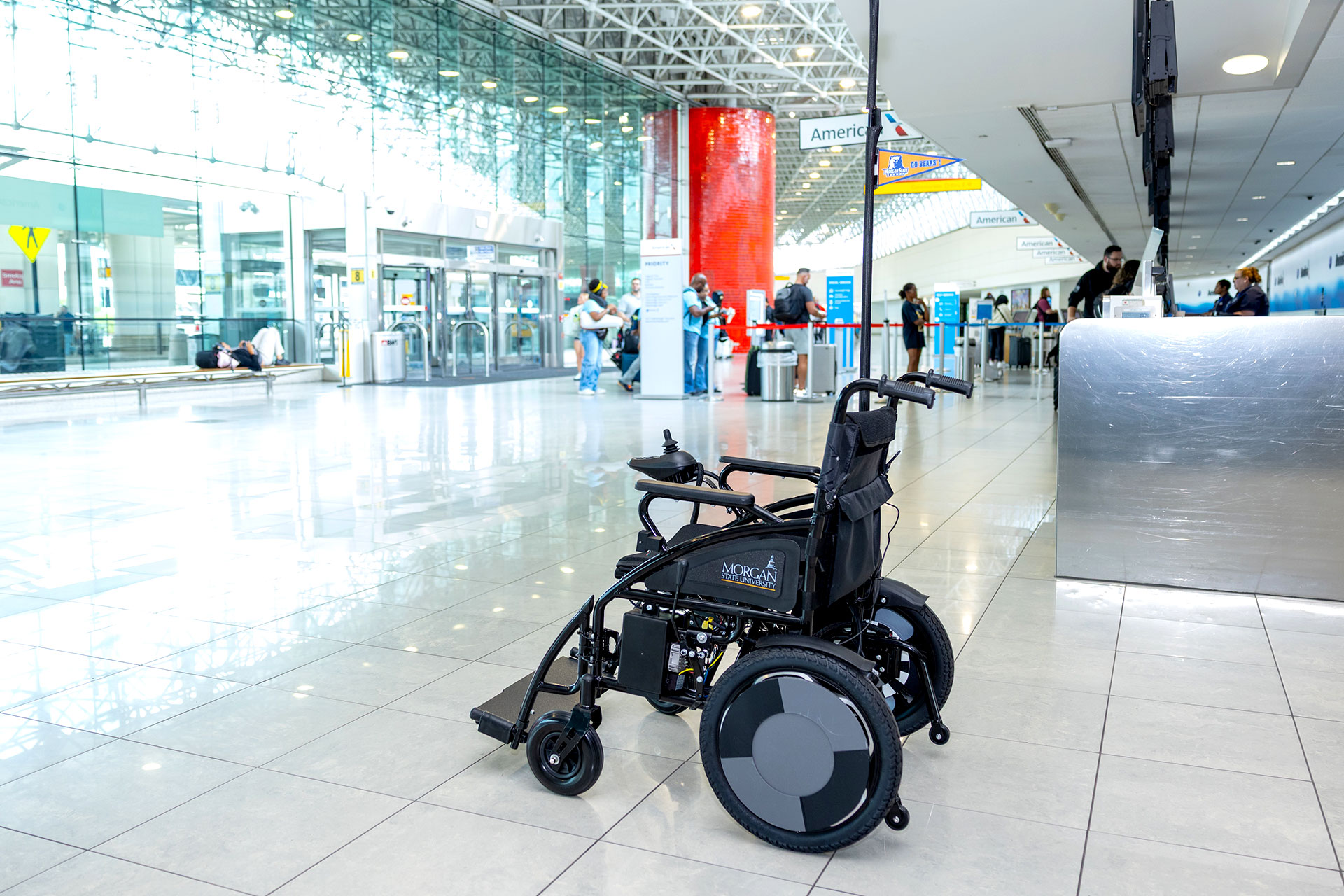
Morgan State University Showcases Innovative Autonomous Wheelchair Technology at BWI Thurgood Marshall Airport
University’s Pilot Program for Mobile App-Based Adaptive Wheelchair Aims to Enhance Mobility Solutions in Public Transportation Spaces
BALTIMORE — At a special demonstration event held at Baltimore/Washington International Thurgood Marshall Airport (BWI Airport), researchers from Morgan State University's National Transportation Center (NTC), Safety and Mobility Advancements Regional Transportation and Economics Research (SMARTER) Center, and Center for Equitable Artificial Intelligence and Machine Learning Systems (CEAMLS) unveiled an innovative autonomous wheelchair technology. This adaptive wheelchair, which was designed to respond to user commands intuitively via a smartphone application, showcased its potential to revolutionize mobility aids in bustling environments like airports.
The demonstration marks the culmination of more than five years of research and development conducted at Morgan State University and in designated areas of BWI Airport. Maryland Lt. Governor Aruna Miller, Assistant Secretary of the Maryland Department of Transportation Juawanna Greene, Maryland Aviation Administration Executive Director and CEO Shannetta Griffin, Maryland Secretary of Disabilities Carol Beatty, and Morgan President David K. Wilson were among those present at the event.

“Today’s demonstration is a significant step towards making public transportation more accessible for everyone,” said President David K. Wilson. “We believe integrating technology into mobility solutions can empower individuals, enabling them to navigate public spaces with ease and confidence. We’re proud of the innovative work being conducted within our research centers to address challenges and offer novel solutions that improve lives.”
The autonomous wheelchair was developed by modifying a conventional powered wheelchair and equipping it with additional instruments that provide perception, navigation, and steering capabilities similar to those used in autonomous vehicles. Researchers installed cameras and LIDAR sensors for perception and a general-purpose single-board computer for processing.
Passengers can summon the autonomous wheelchair through an app by scanning the QR code from the designated areas. They need only to register or log in (if they are already registered) to use the app. The wheelchair will come to their location, and after authentication that the person summoned the wheelchair is the one who summoned it, the passenger can sit on the wheelchair and enter the location that they would like to go. The wheelchair will take them to their destination.

During the demonstration, student operators guided the wheelchair via mobile commands, starting from Door 8 on the terminal's upper level until it reached the ticket counter. From there, the student researchers directed the wheelchair along a predefined route through security checkpoint C, where it successfully underwent security screening with transportation safety agents. Currently, the wheelchair is designed to operate at walking speeds, which range from 2.5 to 4 miles per hour. The demonstration highlighted the University’s commitment to advancing accessible technology that promotes independence and convenience for individuals with mobility challenges.
 “It’s a powerful reminder that transportation isn’t just about planes, trains, and automobiles. And Technology isn’t just about gadgets, apps, and code. And serving the public is not just about policy and programs…it’s about people,” said Lt. Governor Aruna Miller. “It’s about meeting real needs, removing real barriers, and ensuring that everyone, regardless of ability, age, and background, can move through the world freely and access every space, every opportunity, and every moment with confidence and purpose.”
The pilot program began with one wheelchair and has now expanded to three operational wheelchairs. The autonomous wheelchair is currently in its fourth iteration, developed by a team of technicians of varying expertise. It is designed to operate on a guided path, which enhances reliability, allows for more flexible movement, and maximizes its capabilities. The primary goal is to facilitate autonomous travel in large buildings, such as airports, hospitals, museums, college campuses, and military bases.
Researchers have spent the last five years conducting experimentation and testing to ensure operational efficiency and implement best practices. The data collected during the testing and validation phases will significantly influence the public launch of the wheelchair. The pilot program is made possible by way of a collaborative licensing agreement between Morgan State University and the Maryland Aviation Administration, ensuring that Morgan researchers have the space and access necessary to conduct their study and testing at Baltimore/Washington International Thurgood Marshall Airport.
“I do want to acknowledge and thank our colleagues and leaders from Morgan State University for this project and for this demonstration today,” said Shannetta Griffin, executive director and CEO of the Maryland Aviation Administration, during the event. “At BWI Marshall Airport, one of our key areas of focus is to collaborate with stakeholders throughout the community. This project is an example of that partnership.”
The current configuration of the autonomous wheelchair was developed in collaboration by the project’s co-principal investigators: Mansoureh Jeihani, Ph. D., a professor and the director of the National Transportation Center (NTC) and the SMARTER Center, and Kofi Nyarko, Ph. D., a professor in the Department of Electrical and Computer Engineering and the director of CEAMLS at Morgan State University.
 Dr. Jeihani led a team of researchers and students in engineering and constructing the vehicle. This included integrating software and hardware components, such as cameras, LIDAR, computer vision and machine learning models, remote distance measuring devices, and associated computer programming. Under Dr. Nyarko’s leadership, CEAMLS designed the project's technical implementation and served as the team’s primary technical advisor.
"Our team wanted to combine the most cutting-edge AI and computer vision technologies with sensible wheelchair design choices,” said Dr. Jeihani. “Giving people with disabilities this kind of mobility and independence makes public spaces much more inclusive."
The Morgan research team has a pending patent application for an Autonomous Mobility System with the U.S. Patent and Trademark Office. In addition to filing for the patent, Morgan is actively pursuing other opportunities to strengthen its research by securing grant funding and leveraging related research initiatives.
“This project introduces a significant new approach to public spaces, enabling airports to integrate automated systems with personal human interaction effectively,” added Dr. Nyarko. “Our objective is to ensure that all individuals can navigate these options with ease and dignity. Through ongoing research, we will ensure that this device continues to operate in accordance with the highest standards and best practices.”

About Morgan
Morgan State University, founded in 1867, is a Carnegie-classified high research (R2) institution offering more than 150 baccalaureate, master’s degree, doctorate and certificate programs. As Maryland’s Preeminent Public Urban Research University, and the only university to have its entire campus designated as a National Treasure by the National Trust for Historic Preservation, Morgan serves a multiethnic and multiracial student body and seeks to ensure that the doors of higher education are opened as wide as possible to as many as possible. For more information about Morgan State University, visit www.morgan.edu.
# # #
Media Contacts:
Cheryl Stewart or Larry Jones, for Morgan State University PR
443-885-3022
Contact Information
Office of Public Relations & Strategic Communications
1700 East Cold Spring Lane
McMechen Hall Rm. 635
Baltimore, Maryland 21251
Contact Information
Office of Public Relations & Strategic Communications
1700 East Cold Spring Lane
McMechen Hall Rm. 635
Baltimore, Maryland 21251