

Mathematics
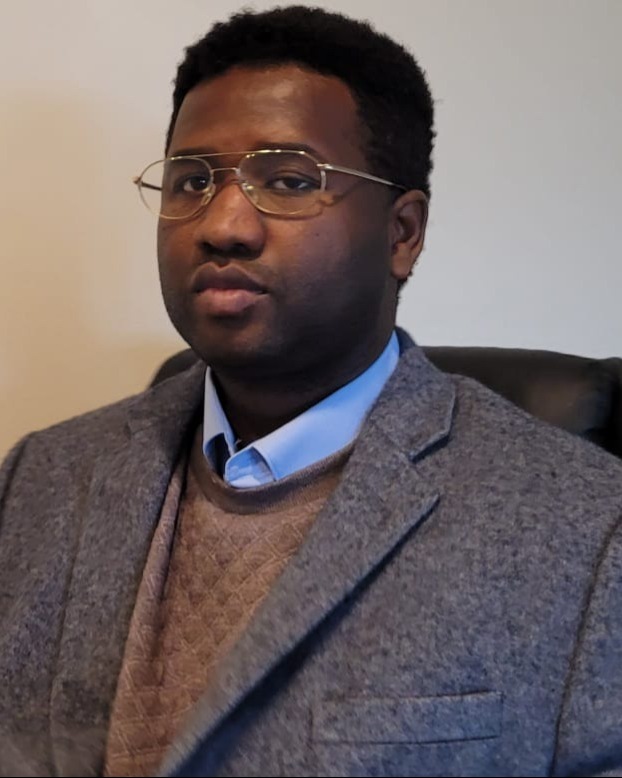
Dr. Chibuike Chiedozie Ibebuchi
Office: 316 Calloway
Phone: 443-885-3964
chibuike.ibebuchi@morgan.edu
Center: Center for Urban and Coastal Climate Science Research
Research Interests
Machine learning & AI applications to climate and environmental health
Disaster risk management (extreme weather—floods, droughts, heat waves, cold snaps—and disease-
vector infestations)
Climate–health linkages
Socioeconomic dimensions of neighborhood environmental degradation in underserved communities
Synoptic climatology
Entomology
Climate variability and change
Electric power systems & grid management (day-ahead price/demand forecasting, load balancing,
market bidding strategies)
Education
Ph.D., Physical Geography (Climate Science) — Julius-Maximilians-Universität Würzburg, Germany, 2023
M.Sc., Hydroscience and Engineering — Technische Universität Dresden, Germany, 2019
B.Tech., Applied Mathematics — Federal University of Technology, Owerri, Nigeria, 2014
Postdoc: Department of Geography, Kent State University (2023-2025)
Editorial Roles
Theoretical and Applied Climatology: Associate Editor (2024-present)
Discover Atmosphere: Associate Editor (2024-present)
Selected Publications
Ibebuchi, C. C., Abu, I. O., & Onwah, S. S. (2025). Environmental factors contributing to southern house
mosquito presence in Clark County, Nevada, using machine learning. Environmental Research
Communications, 7(6), 061005.
Ibebuchi, C. C. (2025). Day-Ahead Energy Price Forecasting with Machine Learning: Role of Endogenous
Predictors. Forecasting, 7(2), 18.
Ibebuchi, C. C., Richman, M. B., Obarein, O. A., Rainey, S., & Silva, A. (2025). Application of an artificial
neural network to improve understanding of the observed conterminous US winter precipitation
response to ENSO. Journal of Geophysical Research: Atmospheres, 130(7), e2024JD041735.
Ibebuchi, C. C., Akinyemi, O., & Abu, I. O. (2025). Selecting observationally constrained Global Climate
Model ensembles using autoencoders and transfer learning. Journal of Geophysical Research: Machine
Learning and Computation, 2(1), e2024JH000528.
Ibebuchi, C. C., & Abu, I. O. (2025). Probabilistic Flood Susceptibility Mapping Using Explainable AI for
the Western United States. Environmental Research Communications.
Ibebuchi, C. C. (2025). Uncertainty in machine learning feature importance for climate science: a
comparative analysis of SHAP, PDP, and gain-based methods. Theoretical and Applied Climatology,
156(9), 1-14.
Abu, I. O., & Ibebuchi, C. C. (2025). Risk assessment of the 2022 Nigerian flood event using remote
sensing products and climate data. Remote Sensing, 17(11), 1814.
Wegener, C., & Ibebuchi, C. C. (2025). Application of xgboost in disentangling the fingerprints of global
warming and decadal climate modes on seasonal precipitation trends in ohio. International Journal of
Climatology, 45(8), e8829.
Ibebuchi, C. C., & Richman, M. B. (2024). Deep learning with autoencoders and LSTM for ENSO
forecasting. Climate Dynamics, 62(6), 5683-5697.
Lee, C. C., Silva, A., Ibebuchi, C., & Sheridan, S. C. (2024). The influence of air masses on human mortality
in the contiguous United States. International journal of biometeorology, 68(11), 2281-2296.
Ibebuchi, C. C. (2024). Redefining the North Atlantic Oscillation index generation using autoencoder
neural network. Machine Learning: Science and Technology, 5(1), 01LT01.
Ibebuchi, C. C., & Lee, C. C. (2023). Global trends in atmospheric layer thickness since 1940 and
relationships with tropical and extratropical climate forcing. Environmental Research Letters, 18(10),
104007.
Ibebuchi, C. C., & Richman, M. B. (2023). Circulation typing with fuzzy rotated T-mode principal
component analysis: Methodological considerations. Theoretical and Applied Climatology, 153(1), 495-
523.
Contact Information
School of Computer, Mathematical, and Natural Sciences
Dr. Paul Tchounwou, Dean
Dixon Science Research Center Rm 200
1700 E. Cold Spring Lane
Baltimore, MD 21251
P: 443-885-4515
E: scmns-deans-office@morgan.edu
Contact Information
School of Computer, Mathematical, and Natural Sciences
Dr. Paul Tchounwou, Dean
Dixon Science Research Center Rm 200
1700 E. Cold Spring Lane
Baltimore, MD 21251
P: 443-885-4515
E: scmns-deans-office@morgan.edu