

Master's in City and Regional Planning
MIT-MSU City Planning Collaborative
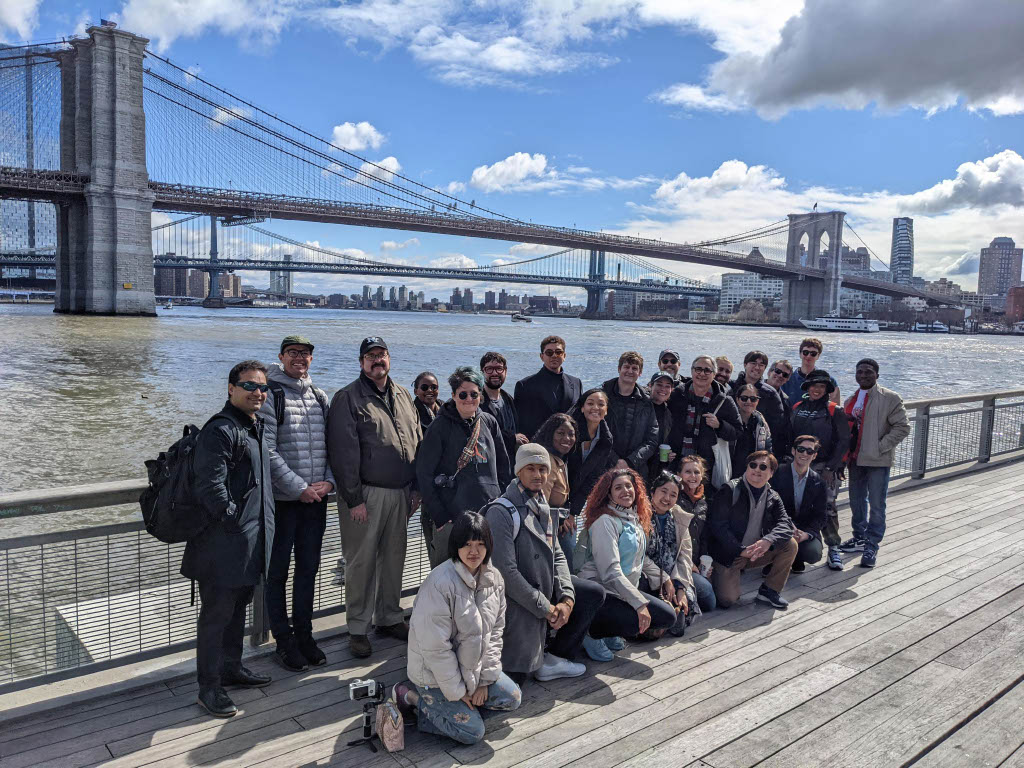
Students and faculty from Morgan State and MIT on a New York City waterfront resiliency tour in April 2024 as part of the MIT-MSU Planning Collaborative.
The MIT-MSU City Planning Collaborative
The Massachusetts Institute of Technology–Morgan State University City Planning Collaborative (MIT-MSU) began in 2020 during the COVID-19 pandemic. In the wake of George Floyd's killing and the subsequent protests that it sparked, professors Brent Ryan (MIT – Department of Urban Studies and Planning) and Daniel Campo (MSU – Department of Design and Planning) began discussing the ways that the planning programs of the two institutions could collectively address urban equity and racial justice issues, and plan for more inclusive and harmonious cities. MIT planning students had just published the Black DUSP Thesis and at the same time, MSU City Planning was facing pandemic-induced budget cuts and other drains on the capacity of the program, which as a Historically Black College and University (HBCU) had long served as a vehicle for enabling Black Americans entry into the profession. Expanding the conversation to include additional faculty members including Ceasar McDowell, Chris Zegras and Holly Harriel from MIT and Siddhartha Sen and Tonya Sanders Thach from Morgan State, the emerging collective decided that addressing the vast gap in resources between the two programs provided a compelling rationale for collaboration – and a starting point for developing broader reforms of urban planning and development practices in and beyond American cities.
MIT-MSU focuses on shared experiences, where students learn together in applied settings of urban planning and development. Leveraging collective faculty expertise, the collaborative is providing students from both programs intimate access to professional planning practices, institutions, histories, and people, and a platform for addressing the critical urban issues of our times. And while MIT-MSU is steered jointly by the participating faculty of the two institutions, consistent with the theme of redistribution, all the funding is provided by MIT.
Thus far the collaborative’s activities have included coordinated classes between the institutions and corresponding reciprocal trips to Cambridge/Boston and Baltimore, as well as trips to New York and Cleveland. MIT-MSU has also expanded to include faculty-to-faculty and faculty-to-student research collaboration, and recently it celebrated its first peer-reviewed publication (between an MSU faculty member and a MIT Ph.D. student). In total, MIT-MSU activities have included participation from over 20 faculty members and 80 students from the two institutions. In 2025, MIT-MSU expanded its scope to include architecture students from both institutions; and in Fall 2025, a trio of coordinated studios, including architecture and planning from MIT and planning from MSU, will develop a plan to build economic opportunity and environmental equity in the South Bronx working with South Bronx United and the New York City Economic Development Corporation.

